Do IT People Make Lousy Poets?
A few days ago, I met someone, a poet, who writes a poetry blog. While chatting with him, I told him that I am not into contemporary poetry - particularly if it is English. I love Tagore, Nazrul, Sukanta and particularly Jibananda (and maybe some Neruda and Langston Hughes in small doses) but that's about it.
He listened attentively and smiled. Then he gently asked me if I was an IT guy. When I confirmed, he said that he found IT people to be less interested in poetry.
The next few days I mulled over his words. I realized I did not like them. But although I knew IT people who have gone on to be novelists, directors, farmers, photographers, musicians, and other kinds of artists, I did not know one who had become a poet.
Was he right?
Poets come out of other professions all the time. William Carlos Williams, for example, was a doctor who kept index cards in his shirt pocket and wrote poems on them whenever he got a break.
(Incidentally, I first read Williams in an IT book - the front of Linear Systems, by Stanford's Thomas Kailath.)
Noodling around the Web, I found a computer scientist who is also a serious poet. One Richard Gabriel, once a Distinguished Engineer at Sun, now at IBM. (And now the programmer in me says, hey, if he is a poet, maybe he is not that good a programmer - did he write any interesting programs? Ha ha.)
Programming is very much a creative process, as is poetry. I can't think of a reason that programmers cannot be poets. Maybe there is something deeper going on? Or have I simply missed a lot of IT poets? Comments?
Such a Small Country
Yeterday at a function I met a well-educated gentleman. Turned out that he worked close to a cousin (someone whose intellect I respect immensely.) I asked my new acquaintance if he knew my cousin. Of course, he said, he has been there for many years. Suddenly he asked, "So are you from Sylhet too?" When I nodded, his eyes narrowed for a fraction of a second- I could almost see some thoughts go across his mind - and the conversation somehow ended quickly.
Now, perhaps he had other people to talk to, and my Sylhetiness had nothing to do with it, but I find that for a country so small, Bangladeshis are ridiculously provincial. "Desh", the Bangla word for country, also means "village home." Often people will ask me "Where is your Desh?" when they mean "Which region of Bangladesh are you from?" "Oh yeah, my Desh is Sylhet, only 35 miles from your Desh of Brahman Baria!" Right.
Then there are the inevitable stereotypes. Tangail, Barisal, Chittagong, Noakhali, Sylhet - we all love to wrap them in unsavory flavors. One day I was going somewhere with a friend who did not know my driver was from Mymensingh. He went on for a few minutes about how stupid, idiotic, moronic Mymensinghis are (I think he was trying to contrast them to the people of the district we were visiting, who he thought were very smart.) To his credit my driver kept quiet. About ten minutes later, when I asked my driver a question, he answered with an ultra-thick Mymesinghi accent - so thick that my friend understood and went red.
All this geographical stereotyping reminds me of my good friend Sanjiv who years ago worked at Siemens. After a reorganization, Sanjiv inherited a new boss. The first question the boss asked Sanjiv was "Are you from India?" Sanjiv's "Yes" caused a flicker of unhappiness to pass through the boss's face. Thus began a very difficult relationship, with boss making Sanjiv's life hell. Eventually Sanjiv moved to another group.
Some time later, Sanjiv found the real story. Years ago, the boss's wife had run off with an Indian man!
Extra! Extra! Goodbye Bangladesh!
Words on the street:
---------
Hawker selling newspapers: "[In English] Goodbye Bangladesh. Goodbye Bangladesh. Sheikh Hasina going to the America. In Bangla] Case being prepared against Khaleda Zia. [Back to English] Goodbye Bangladesh. Goodbye Bangladesh."
---------
Boy to me: "Uncle why are you taking pictures?" "Just for me." "What will you do with them?" "Maybe make a book" "Who will be the author of the book."
This gives me pause. "Hmmm. Not sure. Let me think. Which authors do you like?"
"Not sure. Let me think."
----------
Shopkeeper: [In English]"Uncle do you have one minute. We wanted to talk with you."
Me: [In Bangla] "Arekdin aashbo - I'll come another day."
Shopkeeper: [crestfallen]"Oh, you are a Bangla! Ok, never mind."
----------
Child: "Uncle can you take my picture?" Okay. "Can you take a picture of my little brother here?" Okay. "How about one of me sitting?" Okay. "Wow, you can see the pictures? Looks fine. Hey guys, come take a look." Okay. "Uncle how about a picture of that dog? Do you see the dog over there?" No, I have to go now.
----------
Boy: "Uncle how about a picture? Take one. Please?" Me: "What class do you go to? What is 5 times 12? Do you do your homework or cheat? Have you listened to everything your parents said today?" Boy: "Uh, I have to go now."
----------
The Garrulous Taxi Driver
I had to take a CNG across town the other day. Turned out the driver was talkative with a lot of opinions. (A CNG is a small three-wheeled taxi, running on Compressed Natural Gas, popular in Dhaka.)
Of Bangladeshis he said, "We are the most luxury-loving people in the world." Why, I asked. "Because for only 12 Taka you can get a half-hour ride on a super-luxurious Volvo bus from Mirpur to Farm Gate. A bus that costs 1.5 Crore (about $210,000)! People seem to love it, too" he complained.
His other complaint was about the rich people. There are many families who have 4 or 5 cars now. Not only that, they change models every couple of months. "What do they need so many cars for? No wonder the roads are all clogged up."
We got on the rich people track after he complained how hard it was to make money. "We have to pay Tk 600 every day as rental for this CNG. We have to sweat so much just to earn Tk 200 daily income." He said he was hoping that the rental would drop to 500 soon.
We passed by a strip mall in Gulshan-1 where, among a row of about 10 almost identical storefronts, one had been demolished (because of unpermitted construction.) "Don't you think it is unfair to pick out only one while the others are intact?" I asked. "Not at all, that is a warning sign to the others. If they don't fix their storefronts, they will go, too," he said sternly.
He was optimistic about the country's economy, as I found out in a roundabout way, when he said that the Rangs Building was coming down for sure (this is a controversial Dhaka landmark, reputed to have been built unpermitted.) "But think about it," I said, "there are at least 1000 people who work in that building. Each one supports at least 4 or 5 others. That's a lot of people who will be out of a job." "No problem," he said, "they can get other jobs. They have to just look - there are plenty of jobs."
While he was talking he forgot to tell me that he was almost out of CNG. So we made an unplanned stop in Tejgaon Industrial Area for 15 minutes while he waited in the CNG fillup line, while I took a quick stroll in the underbelly of industrial Dhaka.
Back on the road, he ranted about the CNG business. "These CNGs should have cost only 1-1.5 lac Taka ($1500-2000) but because of the corruption and everyone taking their cuts, the owner had to pay 3-4 lac. That's why poor people like me have to pay Tk 600 a day for renting it," he complained.
Well at least he is not burning petrol. The bill for filling up with CNG (to last him 1.5 days of schlepping people around town) came to Tk 45, about seventy cents.
We reached our destination. The meter read Tk 80 ($1.10) for about 8 miles. I paid him an extra Tk 10 bakhseesh, and with freshly filled CNG tanks our garrulous driver went off to find his next passenger (and captive audience.)
Two Points of View
Little Girl: Man, what a horrible morning! There I was, up bright and early, but Abbu and Ammu wanted to sleep in. I heard Bhaiya and Apu playing by the pond, so I came to join them. Bummer, they would't take me in their game. What could I do? No one would even get me a hanky to clean my nose. So I decided to sit by the pond, stare at the water, and think. Then I hear a noise, turn around, and - YIKES! - this big man had snuck up behind me with a black shiny thing in his hand, pointing it at me. I screamed. I am sure he had a sack in which he wanted to carry me off. And he kept on saying "foto foto." What the heck is a foto? I screamed and screamed and ran for my life, even though Bhaiya and Apu tried to stop me and look at that horrible man. No way. I want Ammu. Ammu! AMMU!
Me: I am bicycling through this village early in the morning, enjoying the scenery and taking pictures. I see two kids playing on the yard by a pond, and another little girl sitting by the pond, staring into the water, lost in thought. It was a perfect moment. Not wanting to disturb her, I parked my bicycle a few feet away and approached the child from behind, very quietly. Just as I composed the photo through the viewfinder and touched the shutter, she heard me and turned around. She froze for a split second, eyes widening in fear, then found her voice, started screaming and ran away. I said "it's just a photo, don't worry, I won't hurt you" and her brother and sister tried to calm her down but to no avail. So I went back to my bicycle and waited for a few minutes. Then I checked back - her screaming had stopped and she had calmed down. But the poor thing was traumatized enough for one day, so I left.
The photo: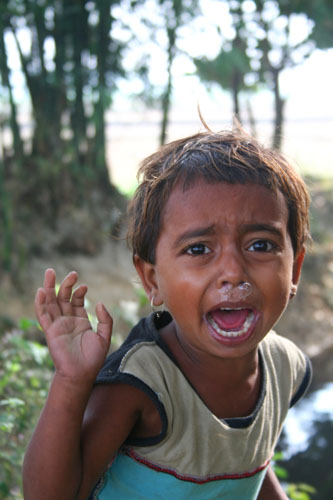
Cow Talk in Old Dhaka
I went to old Dhaka to pick up hard-to-get bicycle parts, then chatted with some locals. Now that we are past Ramzan people's thoughts are on Korbani Eid (when an animal is sacrificed) coming up in two months. The Korbani markets (for buying the sacrificial animals) will begin in earnest in another month, but cow talk has already started in old Dhaka.
So what are popular animals, I asked. "Cows and Khasis, of course", was the answer, "and the rare BhuTTi cow occasionally." BhuTTI cow? (Is this guy pulling my leg?) "It is a small cow, looks very nice, only so high (his hand is at the knees). They fetch a premium price because they are so rare."
Inevitably, talk of prices. "Last year a cow sold for Tk 220,000." Wow, I said, that's pretty high. "It was a big cow," he said, "and beautiful. Very meaty. You could not feel one bone on any part of its body from the outside." How much meat would it yield? "250-300kg, easily." What was it fed? "Better food than humans! Sacks of corn and other good stuff." Who bought it? "Some local commissioner (politician). Used to be only Chittagong merchants could afford these expensive cows, but now there are rich politicians and merchants everywhere."
This Sumo cow had led quite the pampered life. "It had a room of its own. One person was there just to clean up after it all day." And the Dhakaiya finale: "The owner of this cow did not want it to be bitten by mosquitoes, so it slept under a mosquito net every night."
Taxi Driver
Sometimes I commute in a taxi or CNG and get into conversations with the drivers regarding their occupation. They rent the taxis from the owner on a daily basis and pay for all expenses of running the vehicle for the day.
Daily rental: CNG: Tk 600; small blue/black taxi: 800; yellow cab: 900-1050;
Gas (CNG) expenses: Tk 120-150
Daily take-home: Tk 200-500 (after paying daily rental, gas, food)
Biggest pain: 2-3 hour wait at CNG station to fill up
Biggest joy: a long "khep" - to Norsingdi, Bhulta, Tongi, Savar, etc (assuming they don't get caught by a cop for breaking the routing rules)
Busiest day: Friday, when a lot of people go "home" for weekend; others just go out
Slowest day: Saturday - no one wants to go anywhere
Rainy days: can't handle all the people who want a ride
Working hours: 7am to 10 or 11pm.
Working days: alternate days since they need rest after 16 hours of driving
Kms covered in average day: around 300
The masses prefer CNGs over the taxis because of ventilation and mobility/navigability. But on winter days taxis are more in demand, since the open sides of a CNG cannot protect the passengers from cold.
Why do so many drivers say "No" to passengers when their vehicle is empty? Most drivers claim it has to do with the destination. If the passenger wants to go to a location from where it is hard for the driver to find another fare, then they say No. (Hmm, next time I hear a No I might try offering twice the metered fare - that should work, right? The trouble is as soon as I hear that No I am so irritated that there is no way I want to talk to the guy or see his face again!)
courtesy by...
SAGAR RESTUARANT
 |
Sagar Restaurant offers an extensive choice We provide 100% halal meat.of traditional Bangladeshi, Pakistani and Indian cuisine together with new mouthwatering recipes, but if you have a preferred dish that isn't on the menu, please don't hesitate to ask the management who will be more than happy to have our chef specially prepare it for you. |
Jamaica, New York 11432
PHONE: 718-298-5696
718-657-2855
718-213-4338(for catering only)
Web Site: www.sagarfood.com


No comments:
Post a Comment